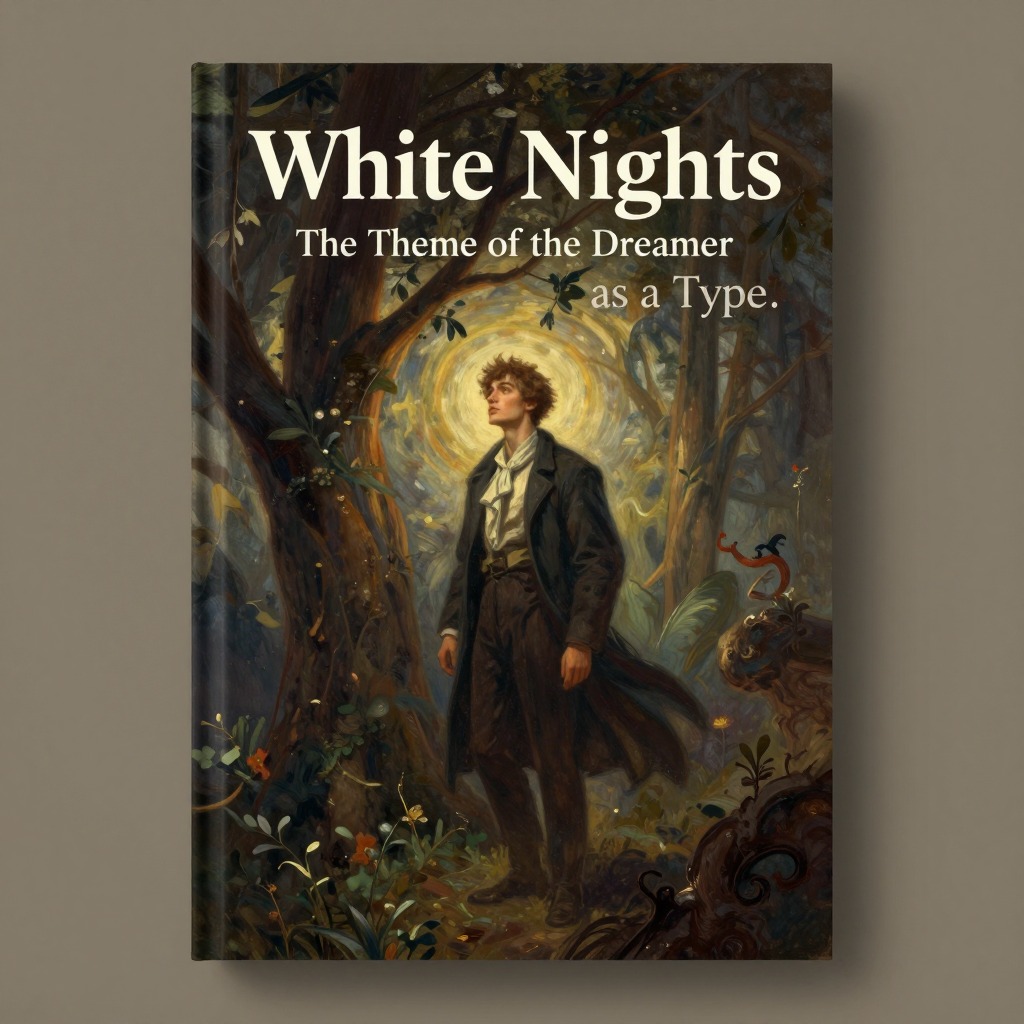
I am a type
The Dreamer's declaration "I am a type" is the pivotal moment of self-definition in Fyodor Dostoevsky's "White Nights." Uttered during his second meeting with Nastenka, this phrase is not a casual remark but a deliberate, almost diagnostic label for his entire mode of being. It encapsulates his identity as a solitary figure, a creature of fantasy who lives a life entirely apart from the ordinary, bustling world of Petersburg. This self-classification becomes the foundation upon which he builds his confession, his story, and his brief, intense connection with the young woman who listens to him.
The Confession of a Type
The Dreamer introduces the concept of "a type" in response to Nastenka's direct question about who he is. He defines it as "an original, it's an absurd person," and immediately links it to the figure of a "dreamer." This is not a simple description but a formal, almost pedantic self-diagnosis. He assumes a "pedantically serious attitude" and begins to speak "as though reading from a manuscript," delivering a lengthy, elaborate monologue that details the life of a dreamer: a person who lives in a "strange nook" of Petersburg, a "creature of an intermediate sort" who grows to his corner "like a snail" or a "tortoise." This confession is a performance, a reading of his own life as a case study, and it reveals the deep, painful self-awareness that underlies his fantastic existence.
The Pain of a Life Lived in Dreams
The Dreamer's confession is not merely a description but a lament. He admits that his life is a "crime and a sin," a wasted existence where he has "lost all my best years." He describes the crushing misery that follows his "fantastic nights," moments of "returning sobriety" when he hears the "whirl and roar of the crowd" living in reality and realizes his own life is "spiritless, monotonous to vulgarity." He speaks of celebrating the "anniversary of my own sensations" for things that "never existed in reality," and of wandering the streets like a "shadow, aimless, sad and dejected." This self-flagellation is a crucial part of his identity as a type: he is not a happy dreamer but a tormented one, fully aware of the gulf between his inner world and the real one.
The Transformation Through Encounter
Nastenka's response to his confession is transformative. She does not mock him but instead offers sympathy and a promise of companionship. She tells him, "Now we shall be two together. Now, whatever happens to me, we will never part." This promise, and the genuine connection it represents, momentarily shatters his identity as a lonely type. He cries out, "I realize now, more than ever, that I have lost all my best years!" and thanks her for being his "good angel." For a brief period, he is pulled out of his solitary fantasy and into a shared, real-life happiness. He plans a future with her, discussing where they will live and how they will take care of her grandmother. This is the only time in the story where the Dreamer steps fully into the realm of actual, shared life, and it is a direct consequence of his confession of being a type.
The Return to the Type
The transformation is brutally reversed. When the Lodger returns, Nastenka immediately leaves the Dreamer, kissing him farewell before rushing to her beloved. The Dreamer is left utterly crushed, and the story's final pages show him reverting to his original state. The morning after, he reads Nastenka's letter of apology and farewell, and his room seems to grow old and dingy around him. He pictures himself "fifteen years hence, older, in the same room, just as solitary, with the same Matrona." The brief, real-life happiness is over, and he is left with only the memory of it. Yet, in a final, poignant act of selflessness, he blesses Nastenka, wishing her a clear sky and a bright smile, and declares that "a whole moment of happiness" is enough for a man's life. This ending confirms that his identity as a type is not a choice but a fate, a permanent condition from which he can only be temporarily, and painfully, released.